Browsing Tag

theology of the body

Catholic Spirituality, Evangelization, Family Life, JPII, motherhood, Parenting, Theology of the Body

Theology of Little Bodies

June 29, 2016

St. John Paul II is my homeboy 4 life. When I have trouble connecting the present moments to eternity, when I wonder how the life after this one could be better/richer/fuller, sometimes it’s the thought of meeting him and falling into his arms for a giant bear hug that reorients me correctly towards heaven.

I’m so grateful, then, to have his intercession from above and his seminal work here on earth, the Theology of the Body (TOB – a series of teachings St. John Paul II gave on human life, love and sexuality – 129 in total – over a 5 year span at the beginning of his pontificate), as a roadmap for this exhausted mother with children who are growing, seeking, asking questions and expecting increasingly complex answers. Even at 4 and 5. Even at 2. (Not so much at 10 months though, but Luke, you know mommy loves you too.)

I don’t have a perfected “method” for beginning to communicate the timeless truths contained in the masterpiece of TOB to people without an advanced theology degree, let alone the ability to write their own names, but happily, that doesn’t seem to matter. Kids are great BS detectors. It’s an innate survival mechanism or something. And they’re equally great truth-receivers. So if you tell them something that is true, they tend to accept it more readily than we world-weary skeptics who wear big boy pants and pay bills do.

The biggest hurdles I have encountered in communicating matters of faith and morals to my children have been my own ego, laziness, and the inertia of daily life.

For example, “Am I doing this right? Is this a great catechetical technique? Can they tell I’m making this up as I go along?” all actually much, much less important than my doing the thing in the first place: having the conversation, answering the hard question honestly, giving a ready and imperfect answer in the moment rather than kicking the can to a more comfortable moment down the road in some nebulous future where I sip placidly on chamomile while discussing Plato’s Republic round the breakfast table.

It’s easy, too, to just lumber along in an unending series of days, lessons, errands, and chores, forgetting that our kids are learning from us as we go along, and that for most parents, the primary transmission of the Faith to the children we’re trying to keep alive will not take place in a lecture setting.

Far from it. There is public nudity and screaming and lots of broken bits of water balloon strewn about the yard while I bark reminders of dignity, modesty, and respecting the neighbors’ point of view. Enhanced (or not) this summer in particular by a critical absence of 5 feet of fence between our yards.

We’ve always tried to speak very honestly about bodies, about the differences between bodies and the dignity we afford to one another and to ourselves, from an early age. They know the proper terms for male and female genitalia. Which I am more or less glad for, but mostly less when checking out at the grocery store. At bath time we remind all butts on deck to treat their siblings with the utmost respect, because God created each of them – body and soul – for a magnificent mission that only they can fulfill. And that they have been created as a gift to the world by a God who loves them, and that their body is part of that gift.

Also, lots and lots of reminders to please put on some underwear.

I’ve heard of a few existing resources for teaching TOB to little people, but haven’t used any of them myself yet. (Here, and here (coming soon) have been suggested to me.)

The basic truths from TOB I’m hoping to communicate them, in whatever way I can hope to achieve while they’re all still south of the age of reason, are these:

Your body is good,

You are your body, just as much as you are your soul, (and you’re in control of that body. So pick up those Legos.)

God has a specific plan for your life, and your body contains the blueprints for it,

God created us, men and women, in His own image, in order to tell us specific things about Himself (in other words: gender is important, intentional, and immutable.)

Anything beyond that gets through to them?  I’m counting it as gravy, at least until middle school.

Any great resources out there I’m missing for starting to lay the foundation for Theology of the Body with little ones?

TOB for kids

Catholics Do What?, Culture of Death, Homosexuality, motherhood, Parenting, Sex, Theology of the Body, Women's Health, Women's Rights

About those bathrooms…

April 28, 2016

I read a great piece this morning on the Target situation du jour from local writer and friend who explained with great compassion and insight why she and her family would still be patronizing the Bullseye, restroom politics notwithstanding. And she took care to explain her position in such a way that I found myself nodding along and agreeing and, well, see for yourself how well thought out and nuanced it is.

I wholeheartedly concur with her assessment that the real threat implicit here is, first and foremost, the opening up of the (relative) safety of the women’s room to a host of unnecessary risks to women, who are naturally more vulnerable and more prone to violence.

And that’s why I’m angry.

Not because I hate transgendered people.

Not because I’m a backwards bigot who has never seen a cross-dresser.

And not because I want my children to live in a bubble of Stepford proportions, clad head to toe in Vineyard Vines and playing with their intentionally-curated pink Barbie houses and blue Matchbox cars. I happen to think that popular distinctions between the sexes are mostly BS, and mostly stereotypical. Playing with tools and cars does not a penis endow, nor does care for the garden or interest in the goings-on of a kitchen qualify you for membership in club uterus. But that’s a whole other post entirely.

No, I’m angry that the conversation has so completely shut out (for the most part) women’s, and particularly mother’s, concerns, and it seems to be more of the same, tired “business as usual, pretty little ladies need not bother themselves” from the mainstream media and on social media.

It strikes me as terribly dismissive – and ironic – that the legitimate concerns for the safety and privacy of roughly half the population (and Target’s bread and butter demographic) are being shoved aside to further a political agenda, on Target’s part, aimed to build their social capital as the unofficial Best Corporate Advocates for What is Currently Cool and Trending.

I think women, along with people in the trans community, are both being used in this equation.

Trans and gender-fluid individuals don’t want attention drawn to their plight the way it has been the past week, I have no doubt. The hatred and vitriol I’ve seen spewed across the internet on both sides of the issue has been breathtaking. And as someone who has written publicly about dog moms, I’ve seen it all, people.)

And on the other hand, concerned mothers are being marginalized and dismissed as hateful bigots because they don’t want creepy pretenders claiming sudden and terribly convenient gender-fluidity-for-the-sake-of-restroom-access using the toilet alongside themselves and their little, and not-so-little, girls.

How, precisely, a Target team member is to be expected to accurately vet the validity of a baseball-clad bro in gym shorts’ claim to a female mind and soul has yet to be convincingly explained to me. Because they didn’t think it through. They didn’t arrive at the logical conclusion that bad people will exploit a bad policy in order to do bad things.

The whole thing smacks of relativism and dismissive “progress” at the expense of, who else, women. Who are and will always be the perennial losers in the sexual revolution.

This move by Target? It was never about better care for people who lay claim to transgenderism. It was about making a political statement and garnering valuable corporate activism capital in the eyes of an increasingly secular marketplace and, even more so, in the echo chamber of social media and the mainstream news cycle.

And the outrage from the other side of the aisle? It was never about marking out or marginalizing or demonizing the “others.” At least not from where I’m sitting, clutching my own proverbial pearls and wondering whether or not my little girl will be safe when she’s in the restroom one day, without me there standing guard outside the stall door.

But now it’s become both of these, because we’ve lost our damn collective minds. And it’s hardly possible to order a coffee without offending someone, bumping up against a competing worldview or accidentally uttering a trigger word. 

Listen, even if we disagree 110% on matters of human sexuality, it is still possibly to have courtesy and mutual respect for one another.

And maybe, for Target and for every other retailer-cum-social engineer out there in the fray, a simpler and more authentically respectful solution to all parties involved would have been the addition of single-occupancy family/individual restroom and dressing room to their stores. (Because you know dressing rooms are coming next.)

But that wouldn’t have been nearly as splashy or, therefore, nearly as sexy.

frogs and lambs

Catholic Spirituality, Catholics Do What?, Culture of Death, Evangelization, motherhood, Parenting, Pornography, Sex, sin, Theology of the Body, toddlers

Porn proof kids and patron saints {part 3 in a series}

April 27, 2016

{Part 1}

{Part 2}

Lately I’ve been writing about — and hearing heart-wrenching accounts of —  people struggling with pornography addiction. It’s rampant in our culture in the West, and the deeper I dig into the statistics and the anecdotes, the more I’m realizing that it is very much a cross-cultural issue, and that even as the internet has transcended geographical boundaries in the best ways, it has been the vehicle for what I suspect history will look back upon as one of the most pernicious evils of our time.

And none of us are immune to it.

But it’s not hopeless.

And the very last thing we’re called to do, as parents, is throw our hands up in the air and resign ourselves to the sad inevitability of our kids and their friends becoming statistics.

So we take the practical steps. We talk to our kids early and often about what pornography is, the real cost of it, emotionally and spiritually and physicallyand we put physical and behavioral barriers in place to protect them and to safeguard the sanctity of our homes.

At the same time, we are called to be salt and light in a world grown dim and flavorless – and increasingly so, where sex is concerned. So we fill our little people’s hearts and minds with truth, goodness, and beauty, and we demonstrate for them what real love looks and feels and sounds like. And we send them out.

Christianity does not belong in a bubble. And neither do little Christian foot soldiers in training. So while do our best to make our home base a sanctuary of love and learning and growing in discipleship and virtue, we must also equip our kids to engage the outside world, bit by bit, bringing the Gospel to their friends and classmates by means of those organic, innocent child-to-child encounters that the very young are so ideally suited for.

Our kids are going to be exposed to evil in this life, but we needn’t resign ourselves to the inevitability their becoming enslaved to it.

By teaching them, using the language of Theology of the Body and the currency of virtue and the grace of the Sacraments, our kids can become little living icons of Christ in a dark and hurting world, and grow up to be the kind of men and women who change history.

St. John Paul II left a great gift to the world in his masterpiece, Theology of the Body. As his wisdom and holiness continues to be distilled into materials that kids and young adults and laypersons of every stripe can readily access, simply entrusting our kids to his heavenly protection is a powerful first step.

A famous story has been circulating on the internet for a couple years now, and it never fails to bring me to tears. Fr. Gabriele Amorth, chief exorcist for the diocese of Rome, was speaking about the effectiveness of invoking different saints during exorcisms. During one encounter, he asked the demon point blank “why do you fear the name of John Paul II so much?” and it replied “Because he pulled so many young people from my hands.”

Mic drop.

Another heavy hitter in the battle for purity, I’ve no doubt: Mother Angelica.

Though she’s only been in heaven (hey, even the Pope thinks so!) a month or so, stories are already circulating about wealthy businessmen (as in, this exact scenario played out more than once!) trolling for porn in their hotel rooms and instead happening upon the oddly captivating image of an elderly nun, sometimes sporting an eye patch, telling them who they really were, and why they deserved to be fed more than garbage.

(Those encounters, by the way, ended up culminating with conversions to Catholicism and massive financial gifts to the ministry and operations of EWTN. Because God can use any of us.)

So we entrust ourselves, and our children, to the mercy of God and the powerful intercession of His saints, and we face the problem of pornography head on, because, in the immortal words of St. Joan of Arc: “I am not afraid. I was born to do this.”

Take heart, moms and dads; So were you.

(This post originally appeared at Catholic Exchange)

porn proof

Catholics Do What?, Contraception, Culture of Death, motherhood, pregnancy, Theology of the Body, Women's Health, Women's Rights

Well, that escalated quickly

February 5, 2016

I mean, I guess if you’re going to break the internet, you might as well do it talking booze and birth control. Two things near and dear to my heart if ever anything were.

If anyone is coming late to the party, hai, glad you’re here, might want to pop over and get the backstory. I’ll wait.

Now that we’re all on the same page, I want to offer a few further thoughts on the situation of the federal government making an official, taxpayer-funded recommendation that women of childbearing age be either completely abstinent from alcohol (not sex, mind you, because that’s like, impossible.) or be continuously contracepting to ensure maximum protection from Fetal Alcohol Syndrome.

Here’s a painfully obvious caveat: FAS is a terrible, preventable condition. Do not binge drink during pregnancy. Actually, I’m going to go a step further and say DO NOT BINGE DRINK EVER. IT’S TERRIBLE FOR YOU, knocked up or not.

(Do not smoke crack, either, even though one intrepid commenter helpfully pointed out it’s, like, way safer than wine. I’m still not 100% on that…)

The overwhelming response (and it was delightfully overwhelming, so thank you!) was fist bumps and high fives. And a few precious messages from my more liberal leaning and even, in one case, pro abortion female readers expressing solidarity with me on this position.

Which is awesome. Just awesome. Because how amazing if government overreach on recommending contraception is what unites women from both ends of the political spectrum in the effort to overhaul and reclaim authentic feminism?

Would be cool. Just saying.

But a few people were very, very concerned that I might be agitating for pregnancy benders. Let me be quite clear when I say, again, FAS is terrible. And you will not give your baby FAS if you drink a glass of wine at a dinner party.

But there have been studies!! I know, I know there have been. But there have been other studies, too. And none of the studies seem to be able to agree on a “safe amount” of alcohol, so it’s easier for the FDA, the CDC, and the other 3 lettered agencies out there to just slap a do not on it and call it a day. Because most women will only be pregnant for 18 perfectly planned, spaced and executed months, anyway, when they go off the pill or have their IUD removed. So it’s no big thing.

This is crazy for 2 reasons.

First, there are plenty of things that are fine in moderation and terrible in excess. I might venture so far as to say that applies to everything. And this applies to pregnant and non pregnant humans alike. And if we’re to believe that the entirety of human history up until this point was dramatically wrong, and that all of Europe is still wrong, and that one drink will doom your child to a life of misery, then…I don’t think there’s anything I can say to convince you otherwise.

Please understand, I’m not encouraging pregnant women to get lit. I’m not even saying they should drink. 

But women who either drank before they knew they were pregnant or have the occasional adult beverage during the 10 months when baby is on board do not need another thing to obsess over. They don’t. There are enough crazy things women already believe about the tenuous grasp on control they pray they have over their lives and the lives of their children. A new year’s eve champagne toast or a Guinness with dinner does not need to be on that list.

Here’s the second crazy thing about the CDC recommendation: it presupposes pregnancy as a predictable, planned, and finite occurrence in a woman’s life, occurring when and where and how she wants it. Once, maybe twice. And then never again. And we can make sure that happens.

Our culture has shifted so dramatically since the advent of the Pill that the above statement doesn’t raise an eyebrow for most modern minds, I’m guessing.

But that’s crazy.

And it’s also the very opposite of “openness to life.”

I think this is where it got weird for some people in trying to understand the outrage from Catholic women, and indeed all women who embrace their fertility and the potential for new life: not as a fearful, high-risk gamble we take once or twice, crossing our fingers and holding our breath, but as a natural extension of our maturation and growth as women and wives and mothers.

If you’re open to life, you’re probably going to spend more time being pregnant. That’s just how it works out. And even while you’re pregnant, life happens. Pregnancy isn’t a horrifying disease or debilitating (well, usually) condition. It’s a natural phase in a woman’s life. And yes, she’s more susceptible to certain ailments and no, she probably shouldn’t be skiing double black diamonds at 8 months along, but for the most part, your life kinda does just go on, just a bit heavier.

So for the government to point a finger at women, the only people capable of conceiving and bearing new life, and say to them “you need to either shut that down or shape up and teetotal,” yes, it was incredibly disturbing and incredibly demeaning.

Because the message is twofold: you’re too ignorant to understand your own (inconvenient!) body, and you’re too reckless to be trusted to behave yourself.

It’s a patronizing, deeply misogynistic message of incompetence and belittlement.

(But then, so is the push to get all women from 13 to 50 on some form of birth control. And we’ve been living that dream for 40 + years.)

I long for the day when all women, regardless of whether they believe in God or practice any religion or even like the taste of beer, recognize that in our bodies we have an intrinsic genius which is uniquely feminine, and it doesn’t need to be turned off or shut down.

It isn’t broken.

We aren’t broken.

But our culture is.

Catholics Do What?, Homosexuality, Marriage, Sex, Theology of the Body

How to discuss gay “marriage” {part 1}

July 20, 2015

A couple weeks ago, right on the heels of the Obergefell decision, a friend and blogger-extraordinairre contacted me with an intriguing invitation: did I want to participate in an online debate of sorts about gay “marriage?” (I’m going to drop the quotes at this point because it’s irritating to keep writing them, but suffice it to say that my position is not that I’m anti homosexual unions, but that by the very definition of the thing, gay “marriage” is physically and ontologically impossible. It literally can’t exist. Hence the quotes.)

Jenna’s idea was refreshingly simple: a back and forth exchange, conducted in charity and civility, with each party stating her position and explaining her reasons behind it. So she rallied a dear childhood friend from San Francisco and yours truly, introduced us to one another by remarking upon our mutual love for California, the Dave Matthews Band, and craft beers, and off we went.

It was fun, but more than that, it was encouraging that at no point did things devolve into name-calling. It was basically the opposite of every Facebook discussion that has ever taken place about anything. And so, in the spirit of hope for the future of public discourse, I’m going to be posting it here all week, inviting you to look over our shoulders as we debated. I hope it’s both instructive and maybe even a little bit inspirational? Not because we’re all that brilliant in our logic, but because here are two people about as fundamentally opposed as is humanly possible on this particular issue, and we didn’t drop any f-bombs or resort to yelling “bigot” in all caps.

So settle in and enjoy. And thanks to Jenna for hosting (and who has the entire exchange posted already, should you find yourselves too impatient to read it in installments. I bet I know how you like to watch your Downton Abbey episodes, too, amiright?)

Part 1:

Cara
I was sitting at work in DC when I heard the news of the ruling. It was coming off the heels of another SCOTUS decision upholding the ACA, and it felt to me like a SCOTUS magic week. The news started to ripple through my office, and we all cheered, breathed sighs of relief, and a few people were walking around waving equality flags that HRC was handing out across the street.

I dove into my iPhone to be sure I knew exactly what this ruling meant and when/how the decision would be implemented. The fact that it was immediate law and that couples could get married right away sounded almost too good to be true. I live in California where marriages have been legal and then annulled with the back-and-forth laws that have been state-driven.

Throughout the day, I started to hear stories like Jack and George, and I shed my cynicism and believed this could really be a turning point.

Quite simply, when I think about what this ruling will mean for the future of our country, I think it means that we are one step closer to equality and that the future is a little brighter. It means stories like Jack and George can finally be a thing of the past and that from this point forward, individuals can marry who they love and enjoy the legal and societal privileges that come with that.

I believe that the next generation will be astounded that this was ever a debate, much the same way that our generation can’t fathom that interracial marriage was illegal less than 50 years ago.

I do still have a very real concern for the future of LGBTQ rights in this country. Same sex marriage is a huge win, but it’s not the end of the fight. There is still incredible discrimination in employment and housing, for example, and the trans community remains one of the most marginalized and vulnerable populations in the US. So, I know there’s a real possibility of the movement losing some momentum after this, which concerns me.

I must say though, this ruling has given me so much hope that hearts and minds really are changing and that acceptance in a concrete, legal form has finally been given to a large community.

Jenny:

My heart sank that Friday morning, when news of SCOTUS’ decision filtered down through my newsfeed. I was scrolling through the news and periodically raising my eyes above the screen to see my kids diving off the couches in the family room. My first thought was “what is this world they are going to inherit?”

My next thought was one that I’m convinced of more and more with each day that has passed since the ruling was handed down: “this is the Roe v. Wade of their generation.”

What I mean by that is twofold, one, that the High Court issued a mandate against the will of the people, as she did back in 1973, further eroding State’s rights and, along with them, the integrity of the American experiment a little more in the process, and two, my children will not grow up in a world without gay “marriage.”

Just as I have never known a world without abortion.

I’m not naive enough to think that our present culture places much value on marriage in any form in 2015. No fault divorce and contraception are rampant, and are lauded as fundamental human rights, so on the one hand, why not allow gay “marriage,” along with polygamy and incest and any other sexual arrangement that happens to come into vogue? We’re certainly not living, culturally speaking, an experience of marriage as a covenant of life-long fidelity and fruitfulness.

But I want more for my kids. I want them to see (please God, let them see) in their parent’s marriage the fruitfulness and the sanctifying grace of Christ present in the exchange of love between spouses. I want them to recognize the profound gift of new life in the face of each new sibling that comes along, and the awesome responsibility that we, their parents, have in co-creating and raising them.

And I want that for everyone else’s children, too.

I want them to experience this impossibly wide, self-denying and cross-carrying and soul-stretching love, whether they are called to the married life or to a celibate vocation. Because that is where real happiness lies. That’s where fulfillment of the deepest variety resides. And nothing the world can offer them in terms of popular sentiment or trending behavior can compete with that.

And so my job as a mother got a little harder on June 27th. Because now I must explain to these children of mine that not all laws are good, and that wherever our human laws stray from the natural law which is written on each of our hearts, there is tremendous suffering.

I see a unique opportunity here to impress upon them the incredible dignity of every human person – no matter their race, religion, sexual preference, socioeconomic status, and all the rest. Because there is surely a wrong way to teach the truth about love and human sexuality, and I’ve seen too much of that these past couple months.

But it’s scary to think that in teaching them the truth about their sexuality and how they were made – for communion with one unique and unrepeatable member of the opposite sex, if they are called to marriage – I am exercising what is now considered “hate speech.” I’ve been called a bigot 100 different ways online these past 3 weeks, and worse than that. Not because I’ve spoken ill of any gay person or suggested homosexuals deserve inferior treatment in the eyes of the law, but because I maintain that marriage is a unique arrangement fundamentally ordered toward the creation of new human life and,because of those new lives, is worthy of protection and distinction in the eyes of the law.

I don’t hate gay people. I don’t hate anyone.

And I don’t believe there is such a thing as gay “marriage,” no matter what 5 unelected public officials and the far more important court of public opinion says about the matter.

People should be allowed to love – and to contract legally binding arrangements with – whomever they please. In my own state, that was already the case.

But I also don’t actually believe this was ever about securing a legal right for a certain class of people, but was rather about abolishing one of the last vestiges of Judeo-Christian morality from American civil law. And it’s going to be a slippery descent downhill, as mentioned above. Because polygamy, incest, and the like are all coming. And on what grounds can we deny anyone a legally-binding and civilly-recognized sexual relationship with any other person – or creature – of their preference? No matter how self-harmful. No matter how disordered. No matter how utterly incapable of producing new life or of investing in the future of a stable and just society.

We can’t. And that’s the world we’re passing on to our children. Not a world of greater equality and opportunity, but of darkened reasoning and of bizarre sexual deviance that everyone will be required, by law, to applaud for with a straight face, affirming that each choice is equally good and loving and valid, because the tyranny of the individual will now rule over the greater common good.
(Stay tuned for part 2 tomorrow.)
Catholics Do What?, Contraception, Culture of Death, NFP, Pornography, Sex, Theology of the Body

Are we all a little over-sexed?

July 6, 2015

It has been suggested to me by certain commenters that I not write or speak about NFP or marriage because woman, know your place, and maybe when you’ve lived it for 35 years you’ll have something worthwhile to contribute. So I tread lightly on forbidden ground here.

But then again, when I think about all the brilliant stuff I’ve read by St. JPII, and as I mentally replay the life-changing lectures I’ve heard by Dr. Janet Smith, I am reassured by the simple fact that you don’t have to have exhaustively experienced a thing  firsthand – or in some cases, even at all – to be able to speak truth about it.

(In fact, in the case of the two aforementioned giants of the intellectual persuasion, perhaps a little bit of distance only enhanced the genius. Certainly seems to have been the case.)

So now drop your expectations nice and low because I’m neither a genius nor a theologian, but I’ve been thinking about the whole messy matter of modern sexual ethics and comparing it to those geniuses, and I keep coming up against this crazy idea that I hope you’ll hear me out on:

I think we’re having too much sex.

More to the point, I think our appetites and our expectations for sex have outstripped reality.

When I say reality, I mean how sex was designed and how we were made, not how “far” we’ve come, technologically, that it is now possible and commonplace to chemically or mechanically sterilize sex to a moderate level of effectiveness in preventing pesky procreative side effects.

I’ve read a few real head scratchers this past week having to do with gay “marriage,” marriage in general, NFP, and what the Church has failed so miserably to communicate to her members.

And with each paragraph consumed, I have become increasingly convinced that we are living in the midst of the most sexually over-satiated and lifeless culture that has ever existed.

We’re all products of this same culture, because each of us, to some extent, have been influenced by the contraceptive mentality of our age, whether through media consumption, personal experience, or education: namely, that sex is primarily about consenting adults getting what’s theirs, and as an afterthought, sometimes babies.

This holds true even among Christians. Even among practicing Catholics who use NFP and pledge allegiance to TOB.

It’s inescapable, to a certain degree. Because we live in the world and yeah, we’re trying not to live of the world, but it’s awfully hard to prevent cross contamination in the digital age.

I’m wondering if some of the very real dissatisfaction in the sexual realm arises because we’re simply having too much of it.

Or, rather, that we’re expecting to be having a whole lot more of it than is realistic. Or even good for us.

I was reading this fascinating piece from 2012 by Elizabeth Scalia that posits the idea of marriage as an office to which some of us – the majority, perhaps – are called, and that certain privileges are afforded to the office of marriage as consolations, sex being the foremost of those privileges.

And by privileges she means those naturally-occuring “graces of office,” if you will, not the popular understanding of privileges as “what I want, when I want it, because I’m entitled to it.”

All these thoughts were rolling about in my insomniac brain last night while I did XL barrel rolls trying to find a comfortable position for my expansive belly, and I remembered a conversation from years ago with a friend whose sister, a high-church Protestant, was preparing for marriage.

Her bridal shower had been held the previous weekend and my friend was recounting the advice doled out by some of the married ladies in attendance. The two main points were as follows:

First, costumes/role play/kinky lingerie: so he doesn’t get bored/tempted. I think the actual wording was “you need to keep things surprising and have him feel like he’s going to be with a different woman from time to time. If you’re his pinup girl, he won’t be tempted by porn.”

I found that…disturbing.

Especially considering the couple being showered were virgins in their young 20’s, and had been maintaining a chaste relationship before marriage. I guess the thought was, rings on, bets off?

Don’t get me wrong, you should absolutely splurge on pretty bed clothes and look hot for your husband, but if the point of costuming is to “trick” the imagination into pretending there’s another woman in his bed entirely, something is very, very wrong. And sexy little pinup wives don’t prevent pornography use: virtuous masculinity does. Chastity and temperance and self mastery does.

Saying no to porn is his job, not yours. You don’t have to compete for his attention, and it’s certainly not your “fault” if the hapless bloke strays. #thesexismoffeminism #punchme

and the second piece of helpful information imparted to the blushing bride to be?

A vow of “whenever, wherever” makes for a happy, healthy marriage and a satisfied man.

This was my first introduction into a now familiar concept, and it is one that hinges absolutely on a highly reliable form of contraception or a uterus of steel and an openness to life that rivals that of St. Catherine of Siena’s parents.

Because if you’re going to solemnly vow to say yes to sex whenever he initiates, no matter how sick/tired/angry/stressed/fertile you are, you’d better have a backup plan for all those double pink lines, to either prevent them or to upgrade your vehicle with real regularity.

But what’s the alternative? Sad, broken marriages with sex in the single digits each month?

Sexually frustrated husbands who turn to prostitutes?

What if, instead, it is our expectations and our appetites that are completely out of proportion with reality?

What if sex, rather than being an adult entitlement, is an immense privilege and a gift? What if we’re actually not entitled to as much of it as we might want?

And what if our past lifestyle choices or sins or the simple pressure of living in a contraceptive culture where everyone else is queuing up in the buffet line has left us with a disproportionate appetite – or at the least, an unrealistic expectation – for sex, period?

What if sex isn’t the be-all, end-all that our culture posits it to be, but a beautiful, consoling, mysterious communion that we are privileged to partake in on the terms of the Author of sex, rather than our own?

Would that help alleviate some of the tension in NFP-using marriages, I wonder?

Would that be a more helpful message to send to young people preparing for marriage, challenging them to rise to the occasion and get real, real good at practicing temperance and self-denial and selfless love now, during their dating and engaged lives, rather than urging them to grit their teeth and run for the nuptial finish line?

And would it perhaps be a better selling point to couples looking to practice NFP in their marriages to admit that yes, it is challenging and requires continuous growth in virtue and selflessness and self control…and that coincidentally, so does marriage. And that it’s so worth it to have a marriage that counters our sick culture.

I speak as a woman and a wife with an imperfect and ordinary marriage which is very much in its infancy. And as a flawed and fallen human being who is, most days, far from capable of the kind of sanctity it daily demands of me.

But I see something worth striving for in this vocation, and I believe utterly that it is I who must adapt to the challenges of this office I have been called to, and not the other way around.

oversexed

About Me, Catholics Do What?, Contraception, Culture of Death, Evangelization, Homosexuality, Marriage, Sex, Theology of the Body

Maybe it’s just love

June 29, 2015

I can list off at least 5 critically-essential relationships in my life, relationships that are soul-feeding, deeply connected, and will hopefully stand the test of time. I am blessed beyond all measure to call these four women and one man my friends: dear, beloved friends with whom I share hopes and fears, dreams and aspirations…but there is one thing that I cannot share with them, even if I wanted to.

I cannot share my very self with them, body and soul, because I have already given that essential gift of my “otherness” to my husband, irrevocably, and for the remainder of his natural life or mine (whoever goes first gets out first, I guess).

And I cannot, no matter how much I might desire to do so, create new life with them.

In the case of the male friend, because it would be a violation of my wedding vows and of the exclusivity of my sexual union with my husband. In the case of my female friends, because it is fundamentally incompatible with human nature. Because it doesn’t work. Egg + egg do not = zygote.

(This has nothing to do with adoption or fostering. That’s a separate conversation that I’m consciously choosing to set aside while we hash out the fundamentals of human nature and our sexual complementarity, so stand by.)

As much as I love these women, reality still stands between our bodies and souls – our similar sexual makeup and fundamental nature render our relationships fundamentally fruitless, from a reproductive perspective.

This isn’t bigotry or bias, it’s basic biology.

And my love for them isn’t cheapened by our inability to contract and consummate a sexual union, it’s simply differentiated.

“Love is love,” according to Twitter and every celebrity on the planet this past weekend…but not all love is marriage. Not all love is fundamentally, at it’s core, ordered to the creation of new human life.

And not all love is sexual.

But, but, they sputter on social media, God made us all and God made gays and lesbians and trans and everyone else, so that means He approves of gay “marriage” because love. And tolerance, you bigot, you.

Super coherent argument, right?

But let’s pick at it a little and see if it stands.

First off, does God have anything to say about marriage? Namely, is He invested in marriage functioning a certain way because He created it?

If you’re operating from a biblical perspective, then yes, from Genesis through Jesus, God has offered repeated input on the man and woman He created, ordering them to be fruitful and to multiply and to let no man divide what He had joined, to point out a few instances of His interest in the institution.

But let’s put aside creed or belief system and come at it from a biological and sociological perspective, since we are now assuredly living in a post-Christian epoch in human history. (By this I mean the law – human law – no longer has recourse to God’s law. We are operating entirely outside of the framework of natural law and divine influence as a society.)

So let’s be secularly frank in this discussion.

Marriage is essentially ordered to the good of … wait for it … the children who may result from it. 

Not just the spouses.

Sure, there are myriad benefits and bonuses that married people enjoy including better health, longer life, greater social support. But the primary purpose of marriage as a secular institution is to protect and guarantee the rights of the weakest and most helpless members of society: children.

And wouldn’t you know it? When we unhitched babies from bonding years ago with widespread acceptance and use of contraceptives, that was the first blow against marriage as a social institution. Married couples could now enjoy sterile, momentary physical pleasure and label it “sex.”

And guess what?

So could non-married people. And people who were married to other people but maybe wanting to experiment a bit with each other just the same.

Pretty soon people who experienced sexual attraction to members of the same sex looked around and realized, huh, marriage doesn’t seem to mean anything about babies anymore, but rather, about adult sexual satisfaction and companionship. And we want that too! 

And who can blame them?

When you trace the beginnings of the decline of the institution of marriage back throughout the past century of human history, you can see clearly the advent of contraceptive use, the rise in extramarital, premarital, anything-other-than-marital sex, and society’s gradual and then (recently) breakneck acceptance of “anything goes, so long as it’s between consenting (for now) adults.”

Because sex, unhinged from the fundamental purpose of bringing forth new life and bonding husband and wife in the sacred and irrevocable role of parenthood, has little consequence beyond the moment. It can still feel good, but then, so can masturbation. So can a one-night stand. So can an affair.

So why not?

Why not, indeed.

That’s why we’re here, today, brave new world in the summer of 2015, shattering the last (and admittedly, in this cultural climate, laughably ridiculous, to hear the reports on most major networks) sexual norm regarding marriage.

Because if divorce is possible, if contraception is a given, if abortion is permitted, if permanent fidelity and the begetting of new human life have nothing to do with marriage, then why the hell not call all bets off?

I think that’s the part we’re going to see a lot of in the next several years. The hell part. We’ll find out, as a culture, whether marriage was a dead and antiquated vestige of the past open to innovative interpretation, or if it really meant something, both to individual lives and to society as a whole.

But the real victims of our little social experiment are going to be the same as always: the weak, the helpless, and the vulnerable: the children.

SCOTUS may have violated jurisprudence, nature, and the Constitution in the laughable logic underpinning Friday’s decision, but we did this to ourselves, as a society, when we rendered sex sterile, profane, and mundane.

Is it any wonder that anyone would question the existence of a sacred institution of marriage when they’re not seeing holy, lasting marriages lived out as an example in real life?

It is particularly telling that the most supportive demographic in the movement for gay “marriage” has been the generation or two of children who’ve come of age in the era of no-fault divorce.

“The sanctity of marriage?” they rightly scoff, “I don’t know anything about that. But I know happiness when I see it, and those guys look happy, so power to them. I sure as hell didn’t see that in my house growing up.”

So that’s our job now, fellow Christians. Parents. People of good will. We must show them what love looks like, in action.

Not saccharine, 140-character professions of devotion or popular opinion. Real, soul-sharing, life-begetting sacrificial love. The cross-shaped kind.

Now the culture war shifts, from broad campaigns to hand-to-hand combat. One marriage, one family, one encounter with Christ at a time.

That’s how we change the world. And that’s how we win eternity.

I begrudge no one the right nor the reality to love who they love. And I will defend to the death your right to believe that.

The Cross is wide enough and the Church is big enough to accommodate all of us sinners, on whatever stage of the journey we find ourselves.

But I will defend to the death the reality of marriage as a different love, a fruitful love, a love bigger than my body or my sexual appetite alone. And I will labor until my last breath to show you that love, His love, made visible through the reality of the invisible grace which sustains our Sacrament.

I hope you’ll defend me too, even in our differing opinions. I hope your tolerance is wide enough for that.

just love

Catholics Do What?, Contraception, JPII, Pornography, Sex, Theology of the Body

Contraception and the Catholic Church: {part 2} What’s wrong with contraception?

June 16, 2015

Yesterday we began with a little overview of the historical background on the practice of contraception and how for 1,900+ years, Christianity uniformly condemned the practice. Today we’re going to delve into the why behind it: why when the rest of the world has heralded the Pill as a technological innovation on par with electricity and the internal combustion engine (seriously, read some of the UN’s documents on women’s rights) Rome has stubbornly refused to capitulate on the matter.

And it’s not because the Church is anti woman. It is, in fact, because She holds women in such high regard and is so intimately concerned with the dignity of women – and men – that She continues to firmly, gently, uncompromisingly say “no.”

It’s the same reason I say no to my kids when they bolt in parking lots and run blindly into the street after a stray soccer ball. It’s the same motivation that compels me to store poison up high and restrict certain media content from entering our home.

I love them.

I love them enough to say no to them even when they’re really, really sure the thing they want to do is worth doing, and is a good to be pursued.

I don’t want them to get hurt, and if I know better, as the wiser, older, well-formed and properly instructed parent, I say no.

Even when it frustrates them. Even when they tantrum.

Because their ultimate happiness is tied to their wholeness and their health, body and soul, and I won’t permit them to inflict self harm in pursuit of a temporary perceived good when I know the long-term cost is one of destruction and heartache.

So what, exactly, is wrong with contraception?

Contraception is anti life because it opposes the creation of new life physically, by preventing fertilization or by means of preventinve sterilization, but it’s also anti life because many popular forms of contracption are actually abortifacient in nature, meaning they are capable of causing early abortions as a secondary line of defense against pregnancy.

Some examples of this are IUDs, the Depo Provera shot, and certain forms of the Pill, including but not limited to the so called “Morning After” pill.

But even those forms of contraception that aren’t capable of causing abortions – condoms or diaphrams or the good old-fashioned withdrawal method, – they’re still anti-life. They still strip away the procreative aspect from sex, and as we understand as Catholics, sex has two fundamental purposes: it is both procreative and unitive.

And in its perfect design, sex is good. It’s very good. There’s no question about it.

Because sex is fundamentally ordered to bring forth new life – it’s literally how God is writing the story of Salvation History, how He continues to bring new life into the world – it is intended to unite and bond the spouses.

So sex is supposed to feel good. It’s supposed to be wildly delightful and desirable. And it is fundamentally ordered toward the creation of new human life. Not every sexual act will result in new life, nor is every act capable of doing so (read: any biology textbook explaining the human reproductive cycle, paying particular attention to the female body) but God designed sex to bring forth babies. Not every time, but a lot of the time. And the Creator of sex – and of people – is the One who has the ultimate say so.

St. JPII was the master of interpretting – and putting into laymen terms – Christian sexual ethics. His early work “Love and Responsibility,” written when he was still Karol Wojtyla, includes sections on mutual enjoyment and sexual satisfaction between spouses that could make a public school health teacher blush. So forget anything you’ve heard about the Church – or God – being anti-sex.

God created sex, and He created sex in order to continue creating us. Think about that!

It’s the only way He chooses to bring new souls into being. So of course it’s an area of life where we are particularly vulnerable to attacks from the enemy, and to our own concupiscience.

God doesn’t surround us with rules and regulations governing the sexual realm because He’s some kind of cosmic killjoy – it’s because sex is so good and so holy, and because it’s where we participate with Him, directly and intimately, in creating the world anew.

But how do you explain this to someone?

It’s a tough pill to swallow in a culture like ours, so obsessed with the idea of sex but with limited experience with the thing itself.

We’ve got plenty of experience with pornography, with sexually explicit content, with sexual innuendo … but with real sex? With the profound communion of persons, united in the sacramental love of spouses, freely giving and receiving the entirety of the Other?

We aren’t as familiar with that.

Our culture styles itself as sexually free and fulfilled, but to look around is to recognize the price we’re paying for this apparent freedom, as individiuals and as a larger community.

Sex, “freed” from the bonds of marriage and the responsibility of parenthood, is actually fairly disastrous. Particularly to women and children.

Rather than making us – especially women – more free, contraception has resulted in deeper slavery – sometimes literally as we witness in the growing global scourge of human trafficking (which is fundamentally enabled by and dependent upon the availability and effectiveness of contraception), and sometimes solely on a spiritul level, no less real, but often unseen and unacknowledged.

Because sex, divorced from love, divorced from its life-giving potential…is just another bodily function. An exchange of fluids and pleasantries, and an opportunity to use and to be used; perhaps with a stranger or perhaps with your spouse.

And this is the antithesis of what God designed it for, designed us for – to give and to receive love.

And in each of those scenarios I mentioned above – the one night stand, the casual relationship, the paid transaction – made possible by the availabilty of contracption, there is damage done to both the relationship and the participants.

Because in reality?

There is no such thing as casual sex.

There is no such thing as protected sex.

And there is no such thing as “safe” sex.

Sex isn’t casual, even if the two (or more!) constenting parties spit shake and swear on it. You can’t unhitch a thing from its meaning just by saying so.

And since sex is not a human innovation but a divine invention, purposefully and intelligently designed for us and for our good…we’re not the ones who get to write the user’s maual on it.

Stay tuned for later this week when we’ll talk about the hard cases, the heartache of infertility, and the fundamental difference between NFP – Natural Family Planning – and contraception.

contraception and the catholic church


{click here for part 1 in the series}


Catholics Do What?, Culture of Death, Homosexuality, Marriage, Theology of the Body

Such a time as this

February 10, 2015

“The U.S. Supreme Court cleared the way for same-sex weddings to start in Alabama, letting the number of gay-marriage states climb in advance of a constitutional showdown that may mean legalization nationwide.

In a 7-2 order, the justices rejected Alabama’s bid to stop a federal trial judge’s legalization order from taking effect Monday. The state now will become the 37th where gays can marry.”

At first glance, this perhaps doesn’t look like much in terms of news. States’ marriage laws have been crashing down left and right like felled timber over the past 2 years, and it’s hardly shocking that Alabama has joined the ranks of the other 36 places in the U.S. where same sex couples can legally contract a “marriage.”

No big deal, right?

Live and let live, and live the life you love, and you love who you love, and all the other platitudes that fill the airwaves and our ears in this modern cultural milieu.

I have some news for us Christians, and maybe it’s going to come as a bit of a shock, but it may well be that none of those clever turns of phrase are going to apply to us before too long.

Make no mistake, this has never been about simply leveling the playing field so that all may freely participate in the institution of marriage; what it is about – what it has always been about – is redefining and recreating marriage into something else entirely.

And when something gets redefined, the old definition is, by necessity, destroyed. Retired into the annals of history, if you will. Marked down as a tried-and-failed social experiment, and abandoned in the name of Progress.

If you believe that Christians, Jews, progressive Muslims, people of other faiths who practice monogamous, heterosexual life-long fidelity within the context of a religious sacrament are going to be allowed to continue to teach, preach, and contract said marriages in peace once gay “marriage” is enshrined as the law of the land, you may be in for an unpleasant surprise.

Maybe not immediately, but highly likely in the not-too-distant future

If you think you’re going to be able to teach your publicly-schooled fourth grader that sex is sacred and reserved for the intimate communion of marriage between husband and wife, you may have another think coming. (And possibly a visit from CPS, to boot.)

Once gay “marriage” becomes the law of the land, it will no longer be possible to hold a competing worldview and still be viewed, either professionally or legally, as a person of good will.

You will be a bigot, first and foremost. A menace to the pluralistic good of a society unshackled from the burdensome moral code of the past. And your kind – our kind – may not be tolerated.

Oh, it might not be a matter of legal troubles, at least not yet. It will probably be a quieter persecution. Passed over for a promotion. Let go from a job. Denied entry to a committee or school organization. Little things like that, white martyrdoms in varying shades of grey.

Because you see, it’s not really possible to live and let live when life trajectories are fundamentally opposed. Something has to give, someone has to yield.

We can’t all be right.

Relativism only works on paper. In real life it plays out like this: someone is right, and someone else is a bigot who is breaking the law.

Marriage can’t be both a monogamous, permanent, life-long commitment between a man and a woman and an open-ended sexual relationship configured by any two consenting adults. The two definitions are fundamentally contradictory.

And while I may be perfectly capable of ignoring the antics and goings-on behind my neighbor’s bedroom doors right now, when I am forced to publicly endorse their lifestyle by the laws of the land, my reality is altered.

Then it’s no longer live and let live, but becomes instead applaud what we do and accept what we teach, because you are now legally bound.

It’s time for us to wake up. Authentic Christian charity doesn’t mean turning a blind eye to social ills and harmful behavior just because they’re fashionable, trending heavily on Twitter, and popular in Hollywood.

I can love my gay brother or sister – and indeed, true love is willing the good of the other – without endorsing the institution of gay “marriage.”

But I may not have that option forever.

One day in the not-too-distant future, it might not be okay to say that in public. It may be something we whisper in private: “oh, we still believe in the Sacrament of Marriage personally, but we can’t talk about it here.”

And you know what? That’s on us. We have been hand-picked, each one of us, to occupy this unique space in this place and time in history. So what witness are you prepared to give, and what defense for the faith you have?

We ought to be praying, fasting, working like crazy to share the goodness and the truth and the beauty of married love. Not sticking our heads in the sand and pulling our kids, our voices, our potential to be influencers and world changers, out of the public square.

We have to be fearless. St. John Paul II said to us, over and over again, “be not afraid.” This is the heart of the Gospel: perfect love that casts out all fear.

I won’t let my fear of what somebody may think of me prevent me from speaking the truth. And so long as we have the freedom to do so, we ought to be speaking it boldly, humbly, inviting people in to the Faith, not cowering in church doorways, bracing ourselves for disaster.

Be not afraid. Over and over again, I have to remind myself. Be not afraid.

Gay “marriage” isn’t going to satisfy the deepest longings of the human heart; only the one Who created us can do that. Let’s invite as many people as we can to experience the truth of that firsthand. Jesus is what this sad, suffering culture of ours seeks, whether or not they know Him by name. And if we center our lives and our marriages on Him, we cannot lose.

Marriage is a beautiful vocation, and it is worthy of being defended. But it is our lived example that speaks volumes to a visually distracted and chaotic culture starved for beauty.
So that awkward encounter with a fellow commuter holding a matching newspaper early in the morning? Be not afraid.

A hard conversation with a beloved friend or college roommate who champions an alternate view of marriage? Be not afraid.

An unpopular stance with your child’s school administration for the sake of your impressionable 5th grader who won’t be participating in the sex-ed program? Be not afraid.

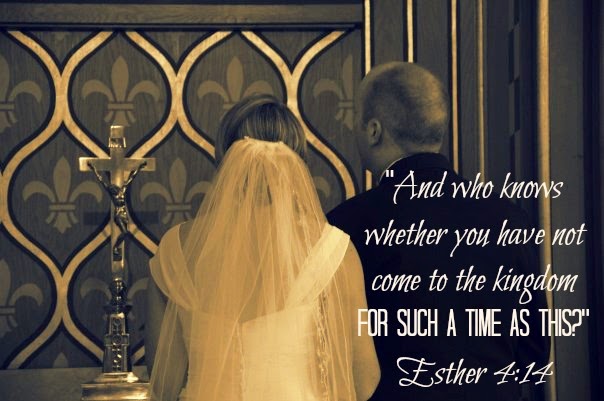
“For if you keep silent at this time, relief and deliverance will rise for the Jews from another place, but you and your father’s house will perish. And who knows whether you have not come to the kingdom for such a time as this?” Esther 4:14
 
31 Days of Writing with the Nester, Abortion, Catholic Spirituality, Catholics Do What?, Contraception, Homosexuality, Marriage, Sex, Theology of the Body

Catholics, sex, and marriage: the elevator pitch

November 1, 2014

Sex is good. It isn’t dirty or naughty or some kind of half-hearted concession to our fallen animalistic nature…it is good, just as it was good in the beginning. Be fruitful and multiply, He said. And so we are, and we do.

And we absolutely have to teach our kids that. Early and often. There’s no such thing as “the talk” in good Christian parenting; rather, it must be a series of talks, spanning childhood into early adulthood, continually drawing children into the beauty and the truth of human sexuality. If you’re waiting until your little snowflake starts middle school to say anything positive or informative about sex and the human person, well, I’m sorry to say it, but you’re about 3 years too late.

We live in a sexually saturated culture, and our children’s eyes and brains are bathed in provocative, violent, and sadistic images of a sexual nature at every turn. It’s our job to combat that with beauty, and goodness, and above all, the truth of who and why they were “created, male and female.”

Marriage is also good. For the majority of people, it’s not only good, but it’s the means of our salvation. If you are called to the Sacrament of Marriage, it is through those graces (and crosses) that you’ll make your way to heaven, leading and alternately being led by the spouse you choose.

Marriage and sex go together. You might even say that attempting to separate them is at the root of almost every problem facing our society. We reserve sex for marriage not out of prudishness or repression, but for the same reason you wouldn’t build a nuclear bomb in the garage: that kind of power demands respect. Mishandle plutonium and you’re going to have a disaster, because you are violating the stuff’s nature. You can’t change nature. You can ignore it, or deny it, or repackage it as something of your own creation, but the stuff is still radioactive.

That’s the reason the Church will never change her position on marriage: she doesn’t have the power to. Marriage is the union between one man and one woman, designed by the Creator of plutonium, etc. to produce brand spanking new humans. We can tinker with the definition and broaden and rewrite all we want…but we can’t alter nature. Even if the State does. Even if every country on earth proclaims marriage to be “an open ended living arrangement featuring a rotating cast of 4 or more adults featuring occasional collaborations with domesticated animals.” Or something. Even then, the Church will not alter her stance on what marriage is, because it isn’t hers to alter.

The Catholic Church’s teachings on sex and marriage are profoundly freeing, which is a shocking claim to make on a libertine, pleasure-worshiping culture. But it’s true! There is such freedom in chastity and fidelity and wild abandonment and trust. And while there’s never a guarantee for happiness, it sure makes sense to stack the deck in your favor when it comes to matters of the heart.

If you think you know what the Catholic Church teaches about sex and marriage, make sure you’ve actually read and learned what the Catholic Church teaches about sex and marriage.

Humanae Vitae

Evangelium Vitae

Letter to Women

Theology of the Body

Sex is good. Marriage is good. Life is very, very good. Now let’s go live it like we believe it.

As a guy I really like was fond of saying,

“Be not afraid.

So, to wrap things up, here’s a tidy 2 minute overview of what Catholics believe about sex and marriage, and why.