Browsing Tag

homosexuality

Catholics Do What?, Culture of Death, Evangelization, Homosexuality, motherhood, Parenting

The innocence of children

January 5, 2016

A couple days back, I nearly broke instagram with a little snap of a super special library book that snuck it’s way into our weekly haul without a proper parental vetting, and then all of a sudden I found myself snuggled up on the couch with a 3 and a 5 year old about to read them a heartwarming tale about gay penguins “whose love was just like the other penguin’s love, but different, you know?”

Whatever your thoughts on homosexuality in the animal kingdom and beyond, you have to admit it’s pretty clever to slip that into an endearing children’s tale to prove your point.

I had one commenter point out the story is based on “the true story of a gay penguin couple” and, therefore, valid and worthy of enshrinement in a taxpayer funded children’s institution. To which I raise my virtual eyebrow and ask, really?

The more disturbing and more common reaction from some of the dissenting Insta commenters, however, dealt with my own great sin: the desecration (actual word used) of public property.

In other words, it was more disturbing that a concerned mother would take a sharpie to a book jacket and issue a frank warning about adult content contained within then that a book promoting homosexuality to children was on the library shelves to begin with.

I can’t remember who said it, but one of the great thinkers of the last century – maybe Chesterton or Lewis – had something to say about how when the great things become unimportant, the little things become too important.

(Wait, I’m going to google it.)

Okay, that’s the first google fail I’ve had in years. 20 minutes and nada to show for it, except that a certain 2-year-old’s nap-aversion siren is going off like a tornado advance warning system.

But the gist of the quote I can’t remember by the great thinker I can’t think of is that when a society has degraded to the point where there are no – or very few – collectively-held incidences of grave evil or injustice, the little things take on a disproportionate great importance.

So when abortion is acceptable, promiscuity is lauded, and every kind of vice is celebrated and encouraged, it suddenly becomes very, very important to Recycle and Eat Local Food and Pick Up Litter.

Not that those things oughtn’t be done, when possible. They are goods in and of themselves! But they are not the greatest goods.

And it is a sad commentary on our collective state of affairs when the outrage my little act of civil disobedience produced was not primarily to do with there being harmful adult content in children’s books expressly designed to indoctrinate them, but that I drew on public property. (Raises taxpaying hand. Cough, cough.)

Anyway, the thing about the whole brouhaha which seemed so disconnected to me was that whether or not it was wrong for me to write a friendly warning in that kid lit volume about homo amorous aquatic birds, the outrage directed at my actions seemed to far outpace any real dismay over the fact that this was a children’s library book.

A book for kids. Meant to educate and inspire and encourage. Meant to feed the soul and enrich the imagination.

And while homosexuality has indeed become increasingly mainstream ala hollywood and prime time television, not everyone, contrary to the belief of the aforementioned media sources, is as gung ho about it as we’ve been led to believe.

It will no doubt get me promptly labelled as hateful and ignorant and prudish and a whole host of other buzzwords that mean “I disagree with your opinion and desire to punish you for it,” but I don’t want my children exposed to the idea that homosexuality is a valid, commonplace lifestyle choice equivalent to marriage.

I also don’t want them exposed to porn, which is why I flip the magazine covers in the checkout line, oftentimes in plain sight of the employees. If pressed, I explain that I’m protecting the eyes of my children, and any others who might come through the line that day. Every time I’ve had this conversation it has led to a sheepish, regretful and even wistful admission that “there’s nothing we can do about it because orders from Corporate, but yeah, we also wish they weren’t there.”

But here’s the thing: if adults do nothing to protect children, they will be victimized by this increasingly sexualized and demonic cultural milieu.

It’s not a matter of “might” or “could be;” they will be.

Sexual deviance in particular is everywhere we turn. And we’re basically, as a culture, in a frog in water situation because we’ve all – me, you, your dad’s friends’s boss – become incredibly desensitized to it by means of the sheer volume of material we’re exposed to every waking second of our lives.

If someone from 1930 could be zapped into modern day prime time and watch 4 minutes of any of our television programing, I think they’d faint dead away. Or maybe throw a hammer through the screen. It’s just that we’re so used to a constant stream of boobs and blood and sexual innuendo and rape scenes and every manner of cruelty and vice, we’re essentially numb to it.

Notice that my aim here is not to condemn the victims of pornography or homosexuality or abortion or any other grave injustice against the human person that we’re currently celebrating as progressive.

Rather, it is to protect my children. Our children. Children whose minds have not yet been formed, whose imaginations are tender and wide open. Who deserve to be filled with truth and beauty and goodness.

I don’t flip magazine covers out of hatred for the women exploited there, but to keep my sons from falling into the legion of men who could one day exploit them.

And I don’t take pen to library books to warn off other parents and young readers out of hatred for those who struggle with homosexuality, but to protect my children from the celebration and normalization of it.

Will we eventually have a conversation that some people struggle with same sex attraction and that their dignity and value is no less than yours, mine, or Mother Teresa’s?

Of course.

But not over a publicly-subsidized piece of progaganda aimed directly at their innocent young hearts, meant not to encourage and inspire but to indoctrinate and anesthetize.

Because I’m an adult, and one of my greatest responsibilities is to the next generation.

Rise up, grown ups.

innocence

Catholics Do What?, Culture of Death, Evangelization, Homosexuality, Marriage, Sex

How to discuss gay “marriage” {part 3: final}

July 22, 2015

Whew, I was thinking of breaking this up into 4 installments but the comments – many of which have been thoughtful and kind and many of which have been … not – are a little bit too much for my very pregnant brain to deal with right now, so I’m going to go ahead and publish one, final installment of my and Cara’s debate today, with the caveat that it’s a little longer than parts 1 and 2.

(And, um, be nice to her, okay? Even if you disagree with her. Actually, especially if you disagree with her. I won’t chastise anyone for the stupid stuff they’re saying to me because I’m a big girl blogger and deal with it every single day. But she doesn’t. So play nice. You don’t score any victories – or convert any hearts – by being cruel.)

Cara:

So funny – USF is my alma mater! Go Dons!

I think we’re getting somewhere because I didn’t even need a deep breath for this one.

I want to be crystal clear here that my support of gay marriage and equal rights for all forms of sexual orientation and gender expression have exactly zero to do with appealing to some popular opinion or “common option.” There is nothing new, trendy, or popular about this. Same-sex love has been around since the beginning of time and all that is news here is that our country is finally coming around to showing this type of love and commitment the respect and legal rights that this community should have been entitled to for all of history.

My point was that there are many people who identify as Catholic who dissent from the fundamental bible-based Catholic teachings on gay marriage (and so, so many other traditional teachings of the Catholic church). A large group of people who believe in God and feel a connection to the Catholic church fully support LGBTQ rights and full acceptance and love of all people (backed by actually supporting all people to love who they love).

Because we have such different core values, it does make sense to me to clearly delineate conservative and liberal Catholics. They are, in practice, such vastly different approaches to life, and to be honest I would be horrified to be bucketed into the traditional Catholic mold. Unfortunately, I think the conservative approach to Catholicism has been much, much louder on a variety of social issues, so the liberal portion of the church has gotten lost in the shuffle. I do think Pope Francis is doing a lot to improve this, and I’m happy to hear we can agree that he’s the best. 🙂

As far as what marriage is and why it is so important, I think you’re right we can leave God out of this, and I want to do just that. While religions all around this globe treat marriage as a sacred and monumental event, that piece is far more complex than what was decided on a Friday in June. The fact is that while religion can put many (valid and important and beautiful) layers on top of marriage, marriage is a legal contract in which each marriage is as unique and diverse as the individuals within the commitment. Some marriages are religious, some are secular, some are between young or older individuals, some span across states or countries, some include children, and some are between same-sex individuals.

 You guessed that I think the point of marriage is for “romantic fulfillment and life-long companionship” and I find that phrasing incredibly empty and not even close to capturing what marriage is. When two people decide that they want to marry, that is an intimate decision that carries with it so many different intentions and goals.

Because of that, I don’t believe there is one “reason” for marriage. I think it depends entirely on the individuals within the relationship. This diversity does extend to whether or not they decide to have children.

Deciding to be a spouse and deciding to be a parent are such different decisions and roles in life, and it is for no one but the couple involved to make decisions about this. Do you know any married couples who have decided to not have children? Do you know any who are unable to conceive? Who have fostered or adopted children? Any who have blended families but have not “created life” together? Do you honestly think these marriages are not valid or living up to some “ideal”?

Your point about children being raised by their biological parents being somehow better off than children of same-sex couples just holds absolutely no water with me. I’m very familiar with the argument that some children raised by same-sex parents are somehow dissatisfied with their upbringing, and I had actually read Katy’s letter before. Some children of ALL forms of childrearing are dissatisfied with parts of their upbringing. There are just as many stories coming from children who are happy with their families, like Zach Wahls. So, this kind of “proof” isn’t proof at all. The stories of all families are complex with varying degrees of success and levels of overall happiness, regardless of the sexual orientation of the parents.


Jenny:

Small world 🙂

Okay, after thinking it over, here’s what I’m understanding to be your 3 main “pros” in favor of gay marriage, and here’s where they’re flawed: 

1. Same sex attraction/homosexual behavior have been around forever, so therefore it should be legally recognized as marriage. This necessitates a change from the fundamental definition of marriage (which I’ll define as a legally binding, life-long, exclusive public commitment to a spouse of the opposite sex and any children which may result from that union) to a broader range of various sexual behaviors. I’m reading that you don’t believe children have anything to do with marriage unless the individual couples wills for them to, and then pursues them in whatever fashion they see fit. Is this accurate so far?

The main issue with this point is the final piece, because this view of marriage radically alters the nature of the institution, which is ordered toward the creation and development of a family, which is the fundamental building block for our larger communities, and turns it into something else entirely: a sexual partnership which is not outwardly-focused, by it’s very nature, but which is focused inward, on the mutual satisfaction and “happiness” (quotes because it’s a completely subjective state unique to each couple) of the spouses.

This is not to say marriage should not equal happiness, but that marriage in the traditional definition often results in happiness but is not contingent upon it. Happiness is a happy aftereffect, if you will, but it’s not proper end. So we contract marriages because we love the other person and want to build a life and a family with them, but the vision is directed outward, away from the individual couples, and that other-centered love physically begets new life. Children are a natural good of marriage – and an essential part of the purpose for marriage – precisely because they draw the spouses away from one another and toward a common good, and ultimately, the future.

You rightly mentioned adoptions and couples who struggle with infertility. I set those aside for the purpose of our argument because they’re tangential, but since you brought them up I’ll answer that when a couple cannot conceive this is a poverty in their relationship. Yes, they may be able to adopt and take great joy in building a family through alternative means (moral means, but that’s another topic entirely), but you’ll never hear an infertile couple say that their infertility hasn’t been a great sadness or a source of suffering. Is their marriage any less valid? Of course not. That’s like saying a cancer patient’s life has less value than a healthy person’s because her body has succumbed to a disease. It means something has gone awry physically.

For a homosexual couple, the sterility of their love is fundamental. That’s part of the reason I said in our first exchange that I don’t believe there is such a thing as gay “marriage;” marriage, by definition, is open to life and directed to the propagation of future generations.

A homosexual relationship can never bring forth new life on its own, and so it cannot be rightly called “marriage” in the real sense of the word. Legal partnership? Sure. Civil union? Ok. But while the government has seen fit to radically alter the definition of marriage to include couples who are fundamentally incapable of fulfilling the essential duties (I’m using that word philosophically) of the office, there is nothing that can be done, legally or semantically, to actually alter the reality that only opposite sex spouses can contract a marital union.

2. When homosexual couples determine that they would like to acquire a child, either through adoption, IVF, surrogacy, etc., this results in a profound commoditization of the child. It reduces the child to a product, if you will, to be added on to their relationship as a kind of familial upgrade.

Do homosexual couples sincerely love the children they bring into their homes and raise as their own? I’m sure they do. But especially in the case of assisted reproductive technologies, there is almost total disregard for the dignity and the autonomy of the child. Their humanity is utterly secondary to wants and desires of the parent(s). Surrogacy is perhaps the saddest example of this commoditization, as it outsources the most fundamental human experience – gestation in your mother’s womb – to an unrelated third party. Does the child have no say in this? And can there really be no consequences to such an impoverished arrangement?

3. I didn’t present Katy’s story as any kind of definitive proof of the inability of a gay couple to raise a happy child, just as food for thought that maybe the children involved in these unions are not being afforded their full rights. We disagree on the nature of marriage as being ordered towards procreation, but there is still an innate drive, even among homosexual couples, to build a family. So the question becomes, what of the rights of the child? Does a child not, as we have legally recovnzzed up until this point, have the right to a mother and a father|? Is it not wrong to preemptively deny them a parent of the opposite sex, simply because two men or two women decide to build a life together?

My final thought is this: if marriage has nothing to do with procreation and building families, then why is the government involved in the first place? Traditionally the government has extended legal protections and benefits to married couples recognizing the unique benefits of marriage to society as a whole, (stable, intact families, healthier citizens, lower crime rates, greater economic stability, etc.) But these all tie into marriages begetting families.

Marriage has been recognized in a unique way because marriage – the sexual relationship between a man and a woman – is uniquely capable of bringing forth the next generation of civilization. Can it be done outside the context of marriage? Well yes, of course. But it’s always at the cost of the children involved, never to their benefit.

Also, if marriage means completely different things to different couples, as you said, if each couple contracts marriage on their own terms and for their own reasons and just wants to call it something that starts with an m….how can there be any kind of legal precedent at all for differentiating what makes the cut and what doesn’t? Can’t I marry my sister? Can’t I marry a second spouse of either gender while my husband is still alive? How is there any grounds, legally, to deny me that?

I’ve really enjoyed the peaceful nature and tone of this exchange (seriously, soooooo refreshing for someone who works on the internet) but I’m not sure we can go much further since it kind of feels like we’re talking past each other on a certain level. We’re using the same language, but we don’t mean the same thing, at all, when we say “marriage.”  So I guess maybe I’m up for one more round of closing arguments, if you will, and then we call it a day?


Cara:

I agree on two points: I really have enjoyed the tone of this, and I think we’re getting to the point of talking past each other in many ways.

There are a number of things I’d like to push back on with what you’ve written here (i.e. those are not my three main points pro gay marriage). I think the fact is that we have wildly different approaches to marriage and family — beyond gay marriage or this particular ruling. I don’t feel the need for closing arguments, per se, as I (thankfully) saw this much more as a conversation than a debate. I would like to offer a couple reflections though.

I will admit that I was a bit nervous going into this. After your first email I had tears in my eyes and ended up going for a couple mile walk with my dog on the beach to de-swell the lump in my throat and unknot my stomach a bit. These types of conversations can be really painful and difficult, but I’m so happy that by this last email I feel better about it all. So — I’m glad we went the email route with this so there was some reflection time built in and an opportunity to compose our thoughts.

Another thing I noticed is that maybe the trick to this is that it didn’t really feel like a debate. We both have clearly thought a lot about this issue and have extremely deep seated beliefs about what is right here. Given that, I think we both quickly knew that we weren’t going to sway the other or “win.” What we could do was explain our stance calmly and (as hard as it may have been for both of us) openly listen to the other side. I think there’s a lot of value in that, and I’m grateful to Jenna for framing this up front that this was to be civil and productive, not a battle or a gotcha debate.

Honestly, I still don’t empathize with your stance at all and I think a lot of what you believe is incredibly harmful to our society, but at the same time I can respect you as an individual and hope that somewhere down the line you have a change of heart as so many people have. And I bet you feel the same about me! At least we’re not apathetic members of society, right? 😉 I do feel sure that we both want what we think is best for our world, and those opinions have been informed and shaped in very different ways.

Best of luck with the tail end of your pregnancy, and sincere thanks for having this conversation.


Jenny:

I have to admit I’m a little relieved, haha. Not because it wasn’t encouraging to engage this way overall, but yeah, because it is a little personally devastating to hear someone so passionately opposed to the deepest knowledge of my heart and my faith.

I was telling my husband last night that it our conversation was making me sad, not for you necessarily, but for our culture at large, just because relativism is so overpowering and pervasive, and it makes fruitful dialogue so difficult.

But He is bigger, and I’ve seen firsthand the fruits of continuing to question and seek and wrestle.

I had a massive reversion to Catholicism in college when St. John Paul II died, and I credit him with saving my life. I’ll be asking him to pray in a special way for both of us,

Enjoy your weekend and God bless your willingness to engage in this.

Catholics Do What?, Homosexuality, Marriage, Sex

How to discuss gay “marriage” {part 2}

July 21, 2015

Picking up where we left off yesterday: a Jesuit and a Franciscan walk into a bar in San Francisco… (click here for part 1)

Cara:

Regardless of how absolutely opposed our views are on this, I do appreciate you sharing your thoughts with me. The shock and sadness I experienced while reading your words made me think about how I really surround myself with likeminded people, for better or worse (no pun intended), and that because of that, I so rarely hear this side of the debate. So, in that way, I’m grateful to hear where you’re coming from and how you think through this issue as it’s honestly a side of the debate I so rarely am up against. Did I mention I live in San Francisco? 😉

There are about a million things I want to say in response, but I thought it might be interesting to look at three big areas where I think we start from the same place and then diverge wildly from a similar origin.

First, I think we both have strong relationships with God and that in big or small ways that is guiding our view on this issue. I was raised in a liberal Catholic home and have kept the main lessons from my childhood as pillars in my adult life. These lessons all center around an impossibly loving and accepting God who creates each of us as intentionally unique and strong individuals who are put on the earth to connect with one another. The God I have known since birth is 100% behind supporting loving gay marriage, and he doesn’t even put quotes around the word marriage! He would urge all of us to fight for the equal rights of everyone in our communities to ensure a safe, just, and loving world.

A couple weeks ago, I marched in the SF Pride Parade with my Jesuit-run graduate school. It felt so great to represent a side of the church that is open and excited about this, as I think our voices are often muddled into “religious people” who are categorically opposed to gay marriage.

Second, I think you’re absolutely right that soul-stretching love (I love that wording!) is where true happiness lies. Marriage is an incredibly beautiful commitment between two individuals. I would bet that both of us know of strong and weak marriages. I can tell you with absolute certainty that two of the strongest marriages among people closest to me are gay marriages filled to the brim with soul-stretching love. One of these marriages was put on hold for decades because of archaic laws, while the other marriage is between two young men who were able to commit themselves to each other through marriage own their own clock because they happen to a reside in a progressive state. I am so happy that couples like these no longer have to hide their love away for their whole lives.

Finally, I think we both agree that the creation of a family within a marriage is something very special and something to protect. While I in no way believe that marriage has anything to do with some responsibility or calling to “create new life”, I do believe that a married couple can provide a loving home for children and a great foundation for a family. Same-sex couples do this equally as well as hetero couples, and this ruling offers an opportunity for the creation of so many more families to be formed with such greater ease and stronger protection. How can one not celebrate that?


Jenny:

I’m actually really enjoying that we can go back and forth without fear of misunderstanding or emotional fallout – so refreshing from what I spend a lot of time doing. Because of work I’m actually in fairly regular debate/discussion with people on both sides of the issue, so I’m not shocked by really…anything, at this point.

Oh, and ha! Just to cement our uncanny likeness a little further, I was born in San Francisco, and raised in the Bay Area. And my spiritual director is a former Jesuit, and my mom is a Santa Clara and USF grad, so maybe one of those is your alma mater too?

To address your first point, I want to challenge the logic of making an appeal to popularity or common option (the other alums and students who dissent from Catholic teaching on gay marriage.) That’s a valid emotional experience for you, but logically it falls under the fallacy “argumentum ad populum,” so it doesn’t strengthen your argument.

I was also raised – and am still a practicing – Catholic, and I don’t like the labels “conservative” or “liberal” – I really think they do more to divide than to unite, and we’re a big ‘ol universal church.

For those who will be reading this, I’d like for us to clarify what marriage is, and what it was created for. Since we’re both coming from a faith angle I think it’s safe to bring that into the conversation, but it could also be made solely from a natural law perspective, so really we could leave God out of it.

He’s already here in our email thread though, so let’s examine what He says about marriage and about human sexuality: first, He created us male and female with a purpose and with a distinct complementarity between our sexualities, to image in a particular way the life-giving exchange of love within the Persons of God, the trinity.

And then the first instruction we receive from Him? Be fruitful, and multiply.

This lays 2 clear imperatives from the creator, first that there is something intelligent and intentional about our sexual differences, and second, that we are intrinsically ordered toward the creation of new life, just as God Himself is.

You say that marriage has nothing to do with children, in your mind, and that is probably the most difficult piece of your argument for me to answer, because it leads me to think we’re not actually discussing the same thing.

If marriage is not primarily ordered toward “the good of the spouses and the procreation and education of offspring,” then what, exactly, is the purpose?

I’m guessing you’re going to say romantic fulfillment and life-long companionship, which are two goods of marriage, but are somewhat periphery to the two primary ends mentioned above. So could it be that we’re not actually talking about the same thing at all?

Like I said in my earlier email, our culture jettisoned the idea of marriage as something intentionally ordered towards bringing forth new life and raising that life in faithful, committed love, but does that cultural rejection actually alter the nature of marriage? What I mean is, can we redefine a thing based solely on popular opinion, considering we didn’t create marriage to begin with?

Finally, I want to challenge – so gently – the notion that children adopted into same sex partnerships do equally well as children raised by their biological parents. It’s simply not been borne out in all the research, and manyadult children of loving, homosexual couples are coming forward and saying that no matter how loving their two “moms” were, and no matter how much they loved them in return, there was a void where the opposite sex parent was missing. And that void impacts them in a real and irrevocable way. I don’t think it’s right to discount the real experiences of children who are living on the front lines of our cultural experimentation and have something hard to tell us, even if it’s difficult to hear. That invalidates their lived experience in the name of furthering an agenda, and unfortunately many of these kids – now adults – are afraid to speak out or do so knowing they’re going to be alienated and rejected by the very community within which they were raised. Katy’s story of her experience being raised in a lesbian household is worth reading.

One final thought: of course children deserve a loving home and of course, orphans and single parent families and all the other impoverished and imperfect arrangements we find ourselves in, when parents die or the crushing demands of poverty overwhelm them, or when teenagers get pregnant or women are abandoned by the men who helped them create the child in question… because we live in a fallen world, and we’re all sinners. But neither of us would, I think, look at those aforementioned situations and call them ideal.

To intentionally deny a child their right to a mother and a father is a grievous injustice to that child. My favorite Jesuit – Pope Francis, says it well: “Children have a right to grow up in a family with a father and a mother capable of creating a suitable environment for the child’s development and emotional maturity.”

So if marriage has nothing to do with children, what is it for? And why should our government take any interest in it, in the first place?

Catholics Do What?, Homosexuality, Marriage, Sex, Theology of the Body

How to discuss gay “marriage” {part 1}

July 20, 2015

A couple weeks ago, right on the heels of the Obergefell decision, a friend and blogger-extraordinairre contacted me with an intriguing invitation: did I want to participate in an online debate of sorts about gay “marriage?” (I’m going to drop the quotes at this point because it’s irritating to keep writing them, but suffice it to say that my position is not that I’m anti homosexual unions, but that by the very definition of the thing, gay “marriage” is physically and ontologically impossible. It literally can’t exist. Hence the quotes.)

Jenna’s idea was refreshingly simple: a back and forth exchange, conducted in charity and civility, with each party stating her position and explaining her reasons behind it. So she rallied a dear childhood friend from San Francisco and yours truly, introduced us to one another by remarking upon our mutual love for California, the Dave Matthews Band, and craft beers, and off we went.

It was fun, but more than that, it was encouraging that at no point did things devolve into name-calling. It was basically the opposite of every Facebook discussion that has ever taken place about anything. And so, in the spirit of hope for the future of public discourse, I’m going to be posting it here all week, inviting you to look over our shoulders as we debated. I hope it’s both instructive and maybe even a little bit inspirational? Not because we’re all that brilliant in our logic, but because here are two people about as fundamentally opposed as is humanly possible on this particular issue, and we didn’t drop any f-bombs or resort to yelling “bigot” in all caps.

So settle in and enjoy. And thanks to Jenna for hosting (and who has the entire exchange posted already, should you find yourselves too impatient to read it in installments. I bet I know how you like to watch your Downton Abbey episodes, too, amiright?)

Part 1:

Cara
I was sitting at work in DC when I heard the news of the ruling. It was coming off the heels of another SCOTUS decision upholding the ACA, and it felt to me like a SCOTUS magic week. The news started to ripple through my office, and we all cheered, breathed sighs of relief, and a few people were walking around waving equality flags that HRC was handing out across the street.

I dove into my iPhone to be sure I knew exactly what this ruling meant and when/how the decision would be implemented. The fact that it was immediate law and that couples could get married right away sounded almost too good to be true. I live in California where marriages have been legal and then annulled with the back-and-forth laws that have been state-driven.

Throughout the day, I started to hear stories like Jack and George, and I shed my cynicism and believed this could really be a turning point.

Quite simply, when I think about what this ruling will mean for the future of our country, I think it means that we are one step closer to equality and that the future is a little brighter. It means stories like Jack and George can finally be a thing of the past and that from this point forward, individuals can marry who they love and enjoy the legal and societal privileges that come with that.

I believe that the next generation will be astounded that this was ever a debate, much the same way that our generation can’t fathom that interracial marriage was illegal less than 50 years ago.

I do still have a very real concern for the future of LGBTQ rights in this country. Same sex marriage is a huge win, but it’s not the end of the fight. There is still incredible discrimination in employment and housing, for example, and the trans community remains one of the most marginalized and vulnerable populations in the US. So, I know there’s a real possibility of the movement losing some momentum after this, which concerns me.

I must say though, this ruling has given me so much hope that hearts and minds really are changing and that acceptance in a concrete, legal form has finally been given to a large community.

Jenny:

My heart sank that Friday morning, when news of SCOTUS’ decision filtered down through my newsfeed. I was scrolling through the news and periodically raising my eyes above the screen to see my kids diving off the couches in the family room. My first thought was “what is this world they are going to inherit?”

My next thought was one that I’m convinced of more and more with each day that has passed since the ruling was handed down: “this is the Roe v. Wade of their generation.”

What I mean by that is twofold, one, that the High Court issued a mandate against the will of the people, as she did back in 1973, further eroding State’s rights and, along with them, the integrity of the American experiment a little more in the process, and two, my children will not grow up in a world without gay “marriage.”

Just as I have never known a world without abortion.

I’m not naive enough to think that our present culture places much value on marriage in any form in 2015. No fault divorce and contraception are rampant, and are lauded as fundamental human rights, so on the one hand, why not allow gay “marriage,” along with polygamy and incest and any other sexual arrangement that happens to come into vogue? We’re certainly not living, culturally speaking, an experience of marriage as a covenant of life-long fidelity and fruitfulness.

But I want more for my kids. I want them to see (please God, let them see) in their parent’s marriage the fruitfulness and the sanctifying grace of Christ present in the exchange of love between spouses. I want them to recognize the profound gift of new life in the face of each new sibling that comes along, and the awesome responsibility that we, their parents, have in co-creating and raising them.

And I want that for everyone else’s children, too.

I want them to experience this impossibly wide, self-denying and cross-carrying and soul-stretching love, whether they are called to the married life or to a celibate vocation. Because that is where real happiness lies. That’s where fulfillment of the deepest variety resides. And nothing the world can offer them in terms of popular sentiment or trending behavior can compete with that.

And so my job as a mother got a little harder on June 27th. Because now I must explain to these children of mine that not all laws are good, and that wherever our human laws stray from the natural law which is written on each of our hearts, there is tremendous suffering.

I see a unique opportunity here to impress upon them the incredible dignity of every human person – no matter their race, religion, sexual preference, socioeconomic status, and all the rest. Because there is surely a wrong way to teach the truth about love and human sexuality, and I’ve seen too much of that these past couple months.

But it’s scary to think that in teaching them the truth about their sexuality and how they were made – for communion with one unique and unrepeatable member of the opposite sex, if they are called to marriage – I am exercising what is now considered “hate speech.” I’ve been called a bigot 100 different ways online these past 3 weeks, and worse than that. Not because I’ve spoken ill of any gay person or suggested homosexuals deserve inferior treatment in the eyes of the law, but because I maintain that marriage is a unique arrangement fundamentally ordered toward the creation of new human life and,because of those new lives, is worthy of protection and distinction in the eyes of the law.

I don’t hate gay people. I don’t hate anyone.

And I don’t believe there is such a thing as gay “marriage,” no matter what 5 unelected public officials and the far more important court of public opinion says about the matter.

People should be allowed to love – and to contract legally binding arrangements with – whomever they please. In my own state, that was already the case.

But I also don’t actually believe this was ever about securing a legal right for a certain class of people, but was rather about abolishing one of the last vestiges of Judeo-Christian morality from American civil law. And it’s going to be a slippery descent downhill, as mentioned above. Because polygamy, incest, and the like are all coming. And on what grounds can we deny anyone a legally-binding and civilly-recognized sexual relationship with any other person – or creature – of their preference? No matter how self-harmful. No matter how disordered. No matter how utterly incapable of producing new life or of investing in the future of a stable and just society.

We can’t. And that’s the world we’re passing on to our children. Not a world of greater equality and opportunity, but of darkened reasoning and of bizarre sexual deviance that everyone will be required, by law, to applaud for with a straight face, affirming that each choice is equally good and loving and valid, because the tyranny of the individual will now rule over the greater common good.
(Stay tuned for part 2 tomorrow.)
Catholics Do What?, Culture of Death, Evangelization, Homosexuality

A useful primer for deciphering newspeak, 2015 edition

June 30, 2015

In light of recent current events leading to a massive explosion of highly effective and cordial debate across all channels of social media, I thought I’d take the time to instruct the confused or under-informed media consumer with this handy guide to understanding the new meanings of words.

(Note: All definitions are subject to change at will, depending upon personal emotional state, hormonal fluctuations, and whether or not the Bachelorette is airing in primetime.)

*Bigot: someone with whom you disagree
*Hate speech: bigot’s (see above) differing opinion
*Intolerance: the bigot’s refusal to concede to your point of view
*Civil debate: unfriending/blocking/reporting someone on social media
*Love: unconditional agreement/concession to your clearly superior point of view
*Science: appeal to invisible/ambiguous higher authority to extinguish further debate

Hope this helps!

Oh, and a few late entries:

*terrorist: your college roommate who attends a repressively orthodox church

*KKK cooperator: that guy you knew in grad school who had the audacity to marry a woman and then last Friday, changed his profile picture to a portrait from his wedding day

*hater: dismissive term meant to shut down further discussion and/or call out a dissenting bigot (see above) on Twitter, hopefully for the purpose of catching his immediate supervisor’s attention and jeopardizing his job

Finally, this video is just really, really good.

About Me, Catholics Do What?, Contraception, Culture of Death, Evangelization, Homosexuality, Marriage, Sex, Theology of the Body

Maybe it’s just love

June 29, 2015

I can list off at least 5 critically-essential relationships in my life, relationships that are soul-feeding, deeply connected, and will hopefully stand the test of time. I am blessed beyond all measure to call these four women and one man my friends: dear, beloved friends with whom I share hopes and fears, dreams and aspirations…but there is one thing that I cannot share with them, even if I wanted to.

I cannot share my very self with them, body and soul, because I have already given that essential gift of my “otherness” to my husband, irrevocably, and for the remainder of his natural life or mine (whoever goes first gets out first, I guess).

And I cannot, no matter how much I might desire to do so, create new life with them.

In the case of the male friend, because it would be a violation of my wedding vows and of the exclusivity of my sexual union with my husband. In the case of my female friends, because it is fundamentally incompatible with human nature. Because it doesn’t work. Egg + egg do not = zygote.

(This has nothing to do with adoption or fostering. That’s a separate conversation that I’m consciously choosing to set aside while we hash out the fundamentals of human nature and our sexual complementarity, so stand by.)

As much as I love these women, reality still stands between our bodies and souls – our similar sexual makeup and fundamental nature render our relationships fundamentally fruitless, from a reproductive perspective.

This isn’t bigotry or bias, it’s basic biology.

And my love for them isn’t cheapened by our inability to contract and consummate a sexual union, it’s simply differentiated.

“Love is love,” according to Twitter and every celebrity on the planet this past weekend…but not all love is marriage. Not all love is fundamentally, at it’s core, ordered to the creation of new human life.

And not all love is sexual.

But, but, they sputter on social media, God made us all and God made gays and lesbians and trans and everyone else, so that means He approves of gay “marriage” because love. And tolerance, you bigot, you.

Super coherent argument, right?

But let’s pick at it a little and see if it stands.

First off, does God have anything to say about marriage? Namely, is He invested in marriage functioning a certain way because He created it?

If you’re operating from a biblical perspective, then yes, from Genesis through Jesus, God has offered repeated input on the man and woman He created, ordering them to be fruitful and to multiply and to let no man divide what He had joined, to point out a few instances of His interest in the institution.

But let’s put aside creed or belief system and come at it from a biological and sociological perspective, since we are now assuredly living in a post-Christian epoch in human history. (By this I mean the law – human law – no longer has recourse to God’s law. We are operating entirely outside of the framework of natural law and divine influence as a society.)

So let’s be secularly frank in this discussion.

Marriage is essentially ordered to the good of … wait for it … the children who may result from it. 

Not just the spouses.

Sure, there are myriad benefits and bonuses that married people enjoy including better health, longer life, greater social support. But the primary purpose of marriage as a secular institution is to protect and guarantee the rights of the weakest and most helpless members of society: children.

And wouldn’t you know it? When we unhitched babies from bonding years ago with widespread acceptance and use of contraceptives, that was the first blow against marriage as a social institution. Married couples could now enjoy sterile, momentary physical pleasure and label it “sex.”

And guess what?

So could non-married people. And people who were married to other people but maybe wanting to experiment a bit with each other just the same.

Pretty soon people who experienced sexual attraction to members of the same sex looked around and realized, huh, marriage doesn’t seem to mean anything about babies anymore, but rather, about adult sexual satisfaction and companionship. And we want that too! 

And who can blame them?

When you trace the beginnings of the decline of the institution of marriage back throughout the past century of human history, you can see clearly the advent of contraceptive use, the rise in extramarital, premarital, anything-other-than-marital sex, and society’s gradual and then (recently) breakneck acceptance of “anything goes, so long as it’s between consenting (for now) adults.”

Because sex, unhinged from the fundamental purpose of bringing forth new life and bonding husband and wife in the sacred and irrevocable role of parenthood, has little consequence beyond the moment. It can still feel good, but then, so can masturbation. So can a one-night stand. So can an affair.

So why not?

Why not, indeed.

That’s why we’re here, today, brave new world in the summer of 2015, shattering the last (and admittedly, in this cultural climate, laughably ridiculous, to hear the reports on most major networks) sexual norm regarding marriage.

Because if divorce is possible, if contraception is a given, if abortion is permitted, if permanent fidelity and the begetting of new human life have nothing to do with marriage, then why the hell not call all bets off?

I think that’s the part we’re going to see a lot of in the next several years. The hell part. We’ll find out, as a culture, whether marriage was a dead and antiquated vestige of the past open to innovative interpretation, or if it really meant something, both to individual lives and to society as a whole.

But the real victims of our little social experiment are going to be the same as always: the weak, the helpless, and the vulnerable: the children.

SCOTUS may have violated jurisprudence, nature, and the Constitution in the laughable logic underpinning Friday’s decision, but we did this to ourselves, as a society, when we rendered sex sterile, profane, and mundane.

Is it any wonder that anyone would question the existence of a sacred institution of marriage when they’re not seeing holy, lasting marriages lived out as an example in real life?

It is particularly telling that the most supportive demographic in the movement for gay “marriage” has been the generation or two of children who’ve come of age in the era of no-fault divorce.

“The sanctity of marriage?” they rightly scoff, “I don’t know anything about that. But I know happiness when I see it, and those guys look happy, so power to them. I sure as hell didn’t see that in my house growing up.”

So that’s our job now, fellow Christians. Parents. People of good will. We must show them what love looks like, in action.

Not saccharine, 140-character professions of devotion or popular opinion. Real, soul-sharing, life-begetting sacrificial love. The cross-shaped kind.

Now the culture war shifts, from broad campaigns to hand-to-hand combat. One marriage, one family, one encounter with Christ at a time.

That’s how we change the world. And that’s how we win eternity.

I begrudge no one the right nor the reality to love who they love. And I will defend to the death your right to believe that.

The Cross is wide enough and the Church is big enough to accommodate all of us sinners, on whatever stage of the journey we find ourselves.

But I will defend to the death the reality of marriage as a different love, a fruitful love, a love bigger than my body or my sexual appetite alone. And I will labor until my last breath to show you that love, His love, made visible through the reality of the invisible grace which sustains our Sacrament.

I hope you’ll defend me too, even in our differing opinions. I hope your tolerance is wide enough for that.

just love

Catholics Do What?, Culture of Death, guest post, Homosexuality, Marriage

“Love wins,” they say

June 26, 2015

Today feels grim. So much hatred pouring out in my newsfeed. Ironically it’s all directed in the name of tolerance, progress, and love.

Love. I don’t think that word means what they think it means.

I wasn’t planning on writing anything at all today, and honestly, I feel too emotional to touch it just yet. Luckily I came across this beautiful, charitable, and deeply true piece by Mary, who blogs at Let Love Be Sincere and is also pregnant with her 4th sweet baby. Mary and her husband, Aaron, are raising their beautiful bi-racial family outside of Detroit, and will soon be adding a little estrogen to the mix. And, ah, they have a little firsthand experience with what actual intolerance looks like. Thanks for sharing your story today, Mary.

Wilkersons Spring 2014 38

This is what my husband wrote on Facebook a few moments ago…

“This decision does not affect me personally as an individual. The way that is does affect me is being a Catholic father raising 4 children in the 21st century. What does today’s decision mean in terms of the world my 4 children will be raised in, one different than the one I came up in?

One of the best things that God gave us is free will, a very powerful gift. However, that gift came with boundaries. To me, I think that the message to my children is that there is the Law of God and the Law of Man. Previously, the two intersected and there wasn’t much of a difference.

Now, they are farther and farther apart from each other and that gap appears to continually increase. One is static and won’t ever change for our benefit and the other is relative and changes with the culture. Today’s decision is a large victory for the Law of Man. It allows people to make their own choices as they see fit for them. I don’t have a problem with that.

My hope is that the Law of Man stays away from the Law of God. My hope is that people do not try to now go into churches and demand that churches marry same-sex couples. Much like churches respect the legal system, even though they may not agree we need to keep the legal system outside of churches whether they agree or not.” – Aaron Wilkerson

My husband is and will probably always be the smartest men I know … and his words perfectly articulate how I and so many others feel about the Supreme Court’s decision today. I didn’t have a strong opinion on what SCOTUS would do; if anything, I knew things would swing this way. But as so many people celebrate, I find myself terribly worried.

I am worried for my children. I hope that the many people who are celebrating today will remember to respect our family’s decision to define the Sacrament of Marriage as different from Legal Marriage. Truth be told, I am not confident that will be the case, and that scares me, for my children … more than I can articulate.

After I heard the Supreme Court decision, my eldest was having a meltdown (someone is always having a meltdown around here.)

So I held him in my arms and rocked him, it was a perfect moment. He was looking up at me and I was looking at him and we were quiet.

It lasted about five minutes, which, at his age, is a lot. As I held him, looking into his eyes, I found myself almost moved to tears with anxiety about how I will raise him in this world. Raise him to know his faith, and to live his faith.

Raise him to stick to his convictions and to our Faith’s understanding of marriage, and sexuality… raise him to always treat people with love and respect, even if they see things differently than we do.

But then I see my Facebook newsfeed flooded with words like bigot, others in an almost hysterical frenzy to describe people like me, people who don’t really care what the government decides to do, but who want to make sure my faith will always be permitted to hold to it’s convictions surrounding traditional sexuality and nature. And I worry, such very real worry, that even his very life could be at risk for holding to those views in a matter of time.

Reactionary? Maybe. But how I’m feeling? Certainly.

And I do think, in case you are wondering, of my gay friends, some of them with children, who are probably looking at their children today, gazing into their eyes and feeling a hope for them that they have never been able to feel before. I know that my worry to them seems silly, as they soak in the joy of what they see as an advancement of culture today.

So, I guess, like Aaron, I just have to hope that maybe this country of ours will at this point in history actually live the words of Christ correctly, the words to “Render unto to Caesar what is Caesar’s and to God what is God’s”- Mark 12

The fear is that it never really works out that way, historically.

Maybe this time will be different.

And so, today, I will continue to pray for love to be more prevalent in the world: real love, good love, love based on sacrifice, the denial of self … the only love that has ever really brought about authentic happiness. His love.

Catholics Do What?, Homosexuality

It was never about the cake

March 31, 2015

From an email blast sent to Helen Alvare’s “Women Speak for Themselves” network of supporters yesterday afternoon:

“Indiana has passed a law which balances religious freedom for citizens, groups and businesses, with the state’s “compelling interests” in requiring everybody to obey this or that particular law which might burden religion.  It is not a remarkable law. The same language was passed federally by a bipartisan Congress in 1993 and signed by President Clinton. About 31 states have such a law either by statute or state constitutional interpretation.” – Helen Alvare, from an email to her WSFT supporters.

Probably you’ve heard once or fifteen times in the past 48 hours how the state of Indiana is trying to time travel back into the Middle Ages and start hunting down practicing homosexuals and publicly flogging them in the town square for their sins of the flesh.At least that’s the narrative our progressive mainstream media is broadcasting via every available channel, be they legitimate news sources or floundering, illogical op-eds by the very openly homosexual CEO’s of very wealthy corporations who are therefore allowed to have  bigger and more important opinions than the average citizen.

And this, y’all? This is crazy.This is the best example of how public opinion – cultivated public opinion carefully crafted and executed by liberal think tanks, billion dollar corporations, and academicians, is becoming the highest power in the land.

In short: laws need not be based in reason or reality, but must instead conform to popular public displays of outrage and emotion.

But there’s a catch.

Some people – let’s call them Christians to simplify the discussion, believe that sex is sacred and, as God revealed in Scripture, is reserved for the exclusive marital relationship between one man and one woman.

Now, Christians believe this to be true because it is true, speaking from a natural law perspective.

God doesn’t make arbitrary thou shalt nots: if He says not to do it, it’s because it’s objectively wrong. So murder. Lying. Stealing. Adultery (translation: sexual involvement with someone other than your spouse).

Do some Christians (and lots of other people) do these things anyway? Of course. Because human nature and original sin and lots and lots of falling down and repenting and getting back up.

But now we have this prevailing cultural trend of not only tolerating a formerly forbidden and immoral behavior – homosexuality – but of openly embracing and celebrating it.

And I’m not speaking here of the person struggling with (or openly celebrating, as is more and more often the case) the disordered behavior and deviant attractions, but the very act of engaging in homosexual behavior. That’s what we’re being compelled to clap and cheer for.

And this bill in Indiana? All it is is the reiteration of an existing 20 year old federal law that 31 other states have some identical version of on the books that pledges protection for those individuals and businesses who don’t choose to jump up and down and cheer.

Does it say that you can discriminate against someone because you disagree with their lifestyle? No. Foolishness.

All it offers is the chance for businesses and individuals who are being compelled by prevailing public opinion and an increasingly invasive federal government to protect themselves from directly violating their own consciences by participating in immoral acts.

Because unless the gay couple coming to ask for a wedding cake is planning on entering into some kind of lifelong platonic union of mutual celibacy, that’s exactly what forcing someone to cater a gay “wedding” is doing: coercing their participation in the public celebration of immoral behavior: homosexuality.

That’s all this law is: an explicit protection for religious citizens who fear (and rightly so) the creeping encroachment of coercive government policies that directly contradict both reality and their deeply held moral beliefs.

But you won’t hear that in the media. Because the gay agenda is powerful, purposeful, and intent upon winning hearts and minds, by force if necessary.

It was never about the wedding cake in the first place. It was always about – and will continue to be about – the systematic redefinition of our collective moral code. 

Catholics Do What?, Culture of Death, Homosexuality, Marriage, Theology of the Body

Such a time as this

February 10, 2015

“The U.S. Supreme Court cleared the way for same-sex weddings to start in Alabama, letting the number of gay-marriage states climb in advance of a constitutional showdown that may mean legalization nationwide.

In a 7-2 order, the justices rejected Alabama’s bid to stop a federal trial judge’s legalization order from taking effect Monday. The state now will become the 37th where gays can marry.”

At first glance, this perhaps doesn’t look like much in terms of news. States’ marriage laws have been crashing down left and right like felled timber over the past 2 years, and it’s hardly shocking that Alabama has joined the ranks of the other 36 places in the U.S. where same sex couples can legally contract a “marriage.”

No big deal, right?

Live and let live, and live the life you love, and you love who you love, and all the other platitudes that fill the airwaves and our ears in this modern cultural milieu.

I have some news for us Christians, and maybe it’s going to come as a bit of a shock, but it may well be that none of those clever turns of phrase are going to apply to us before too long.

Make no mistake, this has never been about simply leveling the playing field so that all may freely participate in the institution of marriage; what it is about – what it has always been about – is redefining and recreating marriage into something else entirely.

And when something gets redefined, the old definition is, by necessity, destroyed. Retired into the annals of history, if you will. Marked down as a tried-and-failed social experiment, and abandoned in the name of Progress.

If you believe that Christians, Jews, progressive Muslims, people of other faiths who practice monogamous, heterosexual life-long fidelity within the context of a religious sacrament are going to be allowed to continue to teach, preach, and contract said marriages in peace once gay “marriage” is enshrined as the law of the land, you may be in for an unpleasant surprise.

Maybe not immediately, but highly likely in the not-too-distant future

If you think you’re going to be able to teach your publicly-schooled fourth grader that sex is sacred and reserved for the intimate communion of marriage between husband and wife, you may have another think coming. (And possibly a visit from CPS, to boot.)

Once gay “marriage” becomes the law of the land, it will no longer be possible to hold a competing worldview and still be viewed, either professionally or legally, as a person of good will.

You will be a bigot, first and foremost. A menace to the pluralistic good of a society unshackled from the burdensome moral code of the past. And your kind – our kind – may not be tolerated.

Oh, it might not be a matter of legal troubles, at least not yet. It will probably be a quieter persecution. Passed over for a promotion. Let go from a job. Denied entry to a committee or school organization. Little things like that, white martyrdoms in varying shades of grey.

Because you see, it’s not really possible to live and let live when life trajectories are fundamentally opposed. Something has to give, someone has to yield.

We can’t all be right.

Relativism only works on paper. In real life it plays out like this: someone is right, and someone else is a bigot who is breaking the law.

Marriage can’t be both a monogamous, permanent, life-long commitment between a man and a woman and an open-ended sexual relationship configured by any two consenting adults. The two definitions are fundamentally contradictory.

And while I may be perfectly capable of ignoring the antics and goings-on behind my neighbor’s bedroom doors right now, when I am forced to publicly endorse their lifestyle by the laws of the land, my reality is altered.

Then it’s no longer live and let live, but becomes instead applaud what we do and accept what we teach, because you are now legally bound.

It’s time for us to wake up. Authentic Christian charity doesn’t mean turning a blind eye to social ills and harmful behavior just because they’re fashionable, trending heavily on Twitter, and popular in Hollywood.

I can love my gay brother or sister – and indeed, true love is willing the good of the other – without endorsing the institution of gay “marriage.”

But I may not have that option forever.

One day in the not-too-distant future, it might not be okay to say that in public. It may be something we whisper in private: “oh, we still believe in the Sacrament of Marriage personally, but we can’t talk about it here.”

And you know what? That’s on us. We have been hand-picked, each one of us, to occupy this unique space in this place and time in history. So what witness are you prepared to give, and what defense for the faith you have?

We ought to be praying, fasting, working like crazy to share the goodness and the truth and the beauty of married love. Not sticking our heads in the sand and pulling our kids, our voices, our potential to be influencers and world changers, out of the public square.

We have to be fearless. St. John Paul II said to us, over and over again, “be not afraid.” This is the heart of the Gospel: perfect love that casts out all fear.

I won’t let my fear of what somebody may think of me prevent me from speaking the truth. And so long as we have the freedom to do so, we ought to be speaking it boldly, humbly, inviting people in to the Faith, not cowering in church doorways, bracing ourselves for disaster.

Be not afraid. Over and over again, I have to remind myself. Be not afraid.

Gay “marriage” isn’t going to satisfy the deepest longings of the human heart; only the one Who created us can do that. Let’s invite as many people as we can to experience the truth of that firsthand. Jesus is what this sad, suffering culture of ours seeks, whether or not they know Him by name. And if we center our lives and our marriages on Him, we cannot lose.

Marriage is a beautiful vocation, and it is worthy of being defended. But it is our lived example that speaks volumes to a visually distracted and chaotic culture starved for beauty.
So that awkward encounter with a fellow commuter holding a matching newspaper early in the morning? Be not afraid.

A hard conversation with a beloved friend or college roommate who champions an alternate view of marriage? Be not afraid.

An unpopular stance with your child’s school administration for the sake of your impressionable 5th grader who won’t be participating in the sex-ed program? Be not afraid.

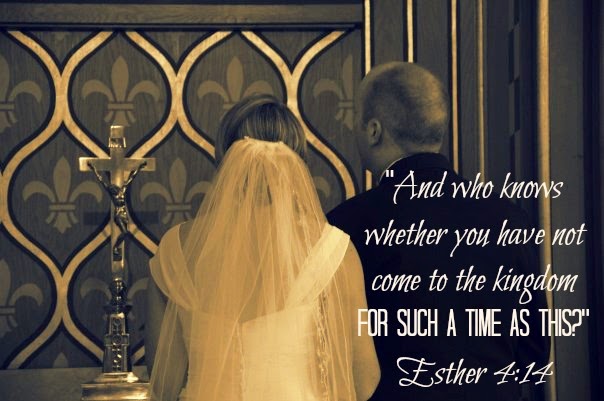
“For if you keep silent at this time, relief and deliverance will rise for the Jews from another place, but you and your father’s house will perish. And who knows whether you have not come to the kingdom for such a time as this?” Esther 4:14
 
31 Days of Writing with the Nester, Abortion, Catholic Spirituality, Catholics Do What?, Contraception, Homosexuality, Marriage, Sex, Theology of the Body

Catholics, sex, and marriage: the elevator pitch

November 1, 2014

Sex is good. It isn’t dirty or naughty or some kind of half-hearted concession to our fallen animalistic nature…it is good, just as it was good in the beginning. Be fruitful and multiply, He said. And so we are, and we do.

And we absolutely have to teach our kids that. Early and often. There’s no such thing as “the talk” in good Christian parenting; rather, it must be a series of talks, spanning childhood into early adulthood, continually drawing children into the beauty and the truth of human sexuality. If you’re waiting until your little snowflake starts middle school to say anything positive or informative about sex and the human person, well, I’m sorry to say it, but you’re about 3 years too late.

We live in a sexually saturated culture, and our children’s eyes and brains are bathed in provocative, violent, and sadistic images of a sexual nature at every turn. It’s our job to combat that with beauty, and goodness, and above all, the truth of who and why they were “created, male and female.”

Marriage is also good. For the majority of people, it’s not only good, but it’s the means of our salvation. If you are called to the Sacrament of Marriage, it is through those graces (and crosses) that you’ll make your way to heaven, leading and alternately being led by the spouse you choose.

Marriage and sex go together. You might even say that attempting to separate them is at the root of almost every problem facing our society. We reserve sex for marriage not out of prudishness or repression, but for the same reason you wouldn’t build a nuclear bomb in the garage: that kind of power demands respect. Mishandle plutonium and you’re going to have a disaster, because you are violating the stuff’s nature. You can’t change nature. You can ignore it, or deny it, or repackage it as something of your own creation, but the stuff is still radioactive.

That’s the reason the Church will never change her position on marriage: she doesn’t have the power to. Marriage is the union between one man and one woman, designed by the Creator of plutonium, etc. to produce brand spanking new humans. We can tinker with the definition and broaden and rewrite all we want…but we can’t alter nature. Even if the State does. Even if every country on earth proclaims marriage to be “an open ended living arrangement featuring a rotating cast of 4 or more adults featuring occasional collaborations with domesticated animals.” Or something. Even then, the Church will not alter her stance on what marriage is, because it isn’t hers to alter.

The Catholic Church’s teachings on sex and marriage are profoundly freeing, which is a shocking claim to make on a libertine, pleasure-worshiping culture. But it’s true! There is such freedom in chastity and fidelity and wild abandonment and trust. And while there’s never a guarantee for happiness, it sure makes sense to stack the deck in your favor when it comes to matters of the heart.

If you think you know what the Catholic Church teaches about sex and marriage, make sure you’ve actually read and learned what the Catholic Church teaches about sex and marriage.

Humanae Vitae

Evangelium Vitae

Letter to Women

Theology of the Body

Sex is good. Marriage is good. Life is very, very good. Now let’s go live it like we believe it.

As a guy I really like was fond of saying,

“Be not afraid.

So, to wrap things up, here’s a tidy 2 minute overview of what Catholics believe about sex and marriage, and why.